परमाणु संरचना, Atomic Number, Mass Number, आवर्त सारणी एवं रासायनिक बंध
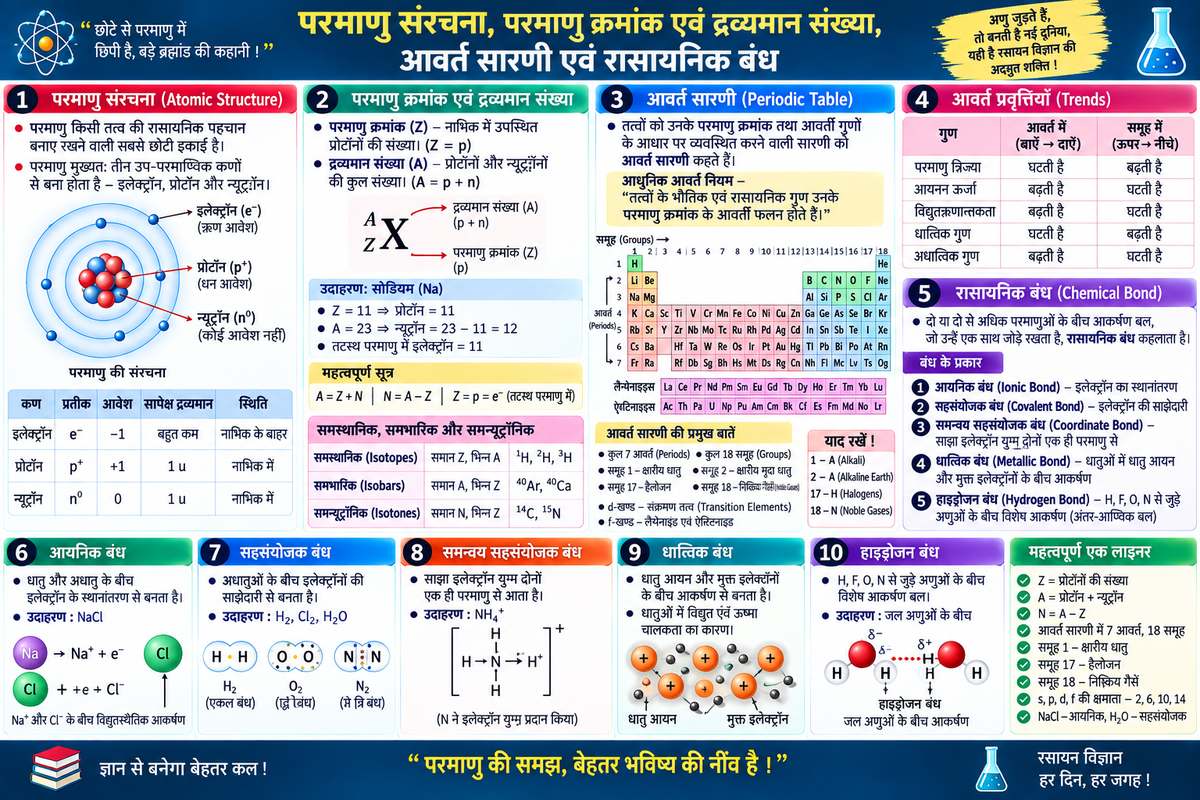
परमाणु संरचना, परमाणु क्रमांक, द्रव्यमान संख्या, आवर्त सारणी एवं रासायनिक बंध
किसी भी पदार्थ को अगर हम लगातार छोटे-छोटे भागों में बाँटते जाएँ, तो अंततः हम परमाणु (Atom) की अवधारणा तक पहुँचते हैं। हमारे आसपास मौजूद पानी, हवा, लोहा, सोना, नमक और यहाँ तक कि हमारे शरीर में उपस्थित पदार्थ भी atoms से बने होते हैं।
लेकिन परमाणु के अंदर क्या होता है? किसी तत्व की पहचान कैसे होती है? परमाणु क्रमांक (Atomic Number) और द्रव्यमान संख्या (Mass Number) में क्या अंतर है? आवर्त सारणी में तत्वों को किस आधार पर व्यवस्थित किया गया है? और अलग-अलग atoms आपस में जुड़कर यौगिक कैसे बनाते हैं?
इन सभी सवालों को समझने के लिए Atomic Structure, Atomic Number, Mass Number, Periodic Table और Chemical Bond को समझना बहुत जरूरी है।
इस article में हम इन चारों topics को आसान और exam-oriented भाषा में समझेंगे।
1. परमाणु संरचना (Atomic Structure)
परमाणु क्या है?
किसी तत्व की रासायनिक पहचान बनाए रखने वाली सबसे छोटी इकाई को परमाणु (Atom) कहते हैं।
परमाणु स्वयं भी छोटे-छोटे उप-परमाण्विक कणों (Subatomic Particles) से बना होता है।
इसके मुख्य कण हैं:
-
Electron
-
Proton
-
Neutron
2. परमाणु के मुख्य उप-परमाण्विक कण
| कण | प्रतीक | आवेश | सापेक्ष द्रव्यमान | स्थान |
|---|---|---|---|---|
| Electron | e⁻ | -1 | बहुत कम | नाभिक के बाहर |
| Proton | p⁺ | +1 | लगभग 1 u | नाभिक में |
| Neutron | n⁰ | 0 | लगभग 1 u | नाभिक में |
याद रखने की Trick
Proton → Positive (+)
Electron → Negative (-)
Neutron → Neutral (0)
3. नाभिक (Nucleus)
परमाणु के केंद्र में स्थित छोटे और अत्यधिक सघन भाग को नाभिक (Nucleus) कहते हैं।
नाभिक में:
-
Proton
-
Neutron
पाए जाते हैं।
इन्हें मिलाकर Nucleons कहा जाता है।
महत्वपूर्ण तथ्य
परमाणु का लगभग पूरा द्रव्यमान नाभिक में केंद्रित होता है, क्योंकि Electron का द्रव्यमान Proton और Neutron की तुलना में बहुत कम होता है।
4. इलेक्ट्रॉन (Electron)
Electron पर ऋणात्मक (-1) विद्युत आवेश होता है।
यह नाभिक के बाहर पाया जाता है और आधुनिक परमाणु मॉडल में इसे निश्चित circular orbit में घूमने के बजाय विभिन्न orbitals/probability regions में पाए जाने के रूप में समझा जाता है।
Electron की व्यवस्था परमाणु के:
-
Chemical properties
-
Valency
-
Chemical bonding
-
Reactivity
को प्रभावित करती है।
5. प्रोटॉन (Proton)
Proton पर धनात्मक (+1) आवेश होता है और यह nucleus में पाया जाता है।
किसी तत्व की पहचान मुख्य रूप से उसके Protons की संख्या से होती है।
यही संख्या Atomic Number (Z) कहलाती है।
6. न्यूट्रॉन (Neutron)
Neutron पर कोई विद्युत आवेश नहीं होता।
यह nucleus में पाया जाता है और atom के mass में महत्वपूर्ण योगदान देता है।
एक ही तत्व के atoms में Neutrons की संख्या अलग हो सकती है। ऐसे atoms को Isotopes (समस्थानिक) कहते हैं।
7. परमाणु मॉडल का विकास
परमाणु की संरचना को समझाने के लिए वैज्ञानिकों ने समय-समय पर अलग-अलग models दिए।
मुख्य वैज्ञानिक:
-
Dalton
-
J.J. Thomson
-
Ernest Rutherford
-
Niels Bohr
-
आधुनिक Quantum Mechanical Model
8. डाल्टन का परमाणु सिद्धांत
John Dalton ने आधुनिक atomic theory की शुरुआत की।
उनके अनुसार पदार्थ बहुत छोटे अविभाज्य कणों से बना है जिन्हें atoms कहा जाता है।
उनके सिद्धांत के कुछ प्रमुख विचार:
-
पदार्थ atoms से बना है।
-
एक ही तत्व के atoms को समान माना गया।
-
अलग-अलग तत्वों के atoms अलग होते हैं।
-
atoms निश्चित अनुपात में मिलकर compounds बनाते हैं।
आधुनिक दृष्टि से संशोधन
Dalton का यह विचार कि atom indivisible है, अब सही नहीं माना जाता क्योंकि atom में electron, proton और neutron जैसे particles पाए जाते हैं।
9. थॉमसन का परमाणु मॉडल
J.J. Thomson ने Electron की खोज की थी।
उन्होंने परमाणु को धनात्मक आवेश के एक गोले के रूप में माना, जिसमें electrons embedded होते हैं।
इसे सामान्यतः Plum Pudding Model कहा जाता है।
Exam Point
Electron की खोज → J.J. Thomson
10. रदरफोर्ड का परमाणु मॉडल
Ernest Rutherford ने Gold Foil Experiment किया।
इस प्रयोग से उन्होंने निष्कर्ष निकाला कि:
-
Atom का अधिकांश भाग खाली होता है।
-
केंद्र में एक छोटा, घना और धनावेशित nucleus होता है।
-
लगभग पूरा positive charge nucleus में केंद्रित होता है।
-
Electrons nucleus के आसपास होते हैं।
Rutherford Model की समस्या
यह model यह स्पष्ट नहीं कर पाया कि electrons nucleus में गिर क्यों नहीं जाते और atomic spectra को पूरी तरह explain नहीं कर सका।
11. बोहर का परमाणु मॉडल
Niels Bohr ने Rutherford model में सुधार करते हुए बताया कि electrons कुछ निश्चित Energy Levels/Shells में पाए जाते हैं।
इन shells को:
K, L, M, N...
से दर्शाया जाता है।
इनकी principal quantum numbers:
n = 1, 2, 3, 4...
होती हैं।
Shell की अधिकतम Electron Capacity
सरल Bohr shell model में किसी shell की अधिकतम electron capacity:
2n²
से दी जाती है।
जहाँ:
n = shell number
उदाहरण
K shell के लिए:
n = 1
2(1)² = 2
अधिकतम 2 electrons
L shell के लिए:
n = 2
2(2)² = 8
अधिकतम 8 electrons
M shell के लिए:
n = 3
2(3)² = 18
अधिकतम 18 electrons
N shell के लिए:
n = 4
2(4)² = 32
अधिकतम 32 electrons
Exam में basic electronic configuration के लिए 2n² rule बहुत महत्वपूर्ण है।
12. आधुनिक परमाणु मॉडल
आधुनिक Quantum Mechanical Model के अनुसार electron को nucleus के चारों ओर किसी निश्चित circular path पर घूमते हुए नहीं माना जाता।
इसके बजाय electron के पाए जाने की संभावना वाले क्षेत्र को Orbital कहा जाता है।
मुख्य orbitals:
-
s
-
p
-
d
-
f
Maximum Electron Capacity
| Orbital | अधिकतम Electrons |
|---|---|
| s | 2 |
| p | 6 |
| d | 10 |
| f | 14 |
Exam Trick
s = 2, p = 6, d = 10, f = 14
13. परमाणु क्रमांक (Atomic Number)
किसी परमाणु के nucleus में उपस्थित Protons की संख्या को परमाणु क्रमांक (Atomic Number) कहते हैं।
इसे Z से दर्शाया जाता है।
सूत्र
Z = Number of Protons
यदि atom neutral है:
Number of Protons = Number of Electrons
इसलिए neutral atom के लिए:
Z = p = e
उदाहरण
Hydrogen में:
Protons = 1
इसलिए:
Atomic Number = 1
Oxygen में:
Protons = 8
इसलिए:
Atomic Number = 8
Carbon में:
Protons = 6
इसलिए:
Atomic Number = 6
14. परमाणु क्रमांक का महत्व
Atomic Number किसी तत्व की पहचान (Identity) निर्धारित करता है।
उदाहरण:
-
Z = 1 → Hydrogen
-
Z = 6 → Carbon
-
Z = 8 → Oxygen
-
Z = 11 → Sodium
-
Z = 17 → Chlorine
-
Z = 26 → Iron
यदि किसी atom में protons की संख्या बदल जाती है, तो वह अलग element बन जाता है।
15. द्रव्यमान संख्या (Mass Number)
किसी परमाणु के nucleus में उपस्थित Protons और Neutrons की कुल संख्या को Mass Number कहते हैं।
इसे A से दर्शाया जाता है।
सूत्र
A = Number of Protons + Number of Neutrons
अर्थात:
A = Z + N
जहाँ:
-
A = Mass Number
-
Z = Atomic Number
-
N = Number of Neutrons
इसलिए:
Neutrons का सूत्र
N = A − Z
यह formula परीक्षा में बहुत महत्वपूर्ण है।
16. Atomic Number और Mass Number में अंतर
| आधार | Atomic Number (Z) | Mass Number (A) |
|---|---|---|
| अर्थ | Protons की संख्या | Protons + Neutrons |
| Formula | Z = p | A = p + n |
| Electron से संबंध | Neutral atom में Z = e | Electron शामिल नहीं |
| पहचान | Element की पहचान निर्धारित करता है | Isotope की पहचान में उपयोगी |
| उदाहरण | Carbon का Z = 6 | Carbon-12 का A = 12 |
सबसे महत्वपूर्ण बात
Atomic Number = केवल Protons
Mass Number = Protons + Neutrons
17. उदाहरण से समझें
मान लीजिए किसी atom का:
Atomic Number = 17
Mass Number = 35
तो:
Protons = 17
Neutral atom में Electrons = 17
Neutrons:
N = A − Z
N = 35 − 17 = 18
अर्थात:
-
Proton = 17
-
Electron = 17
-
Neutron = 18
18. Isotopes (समस्थानिक)
एक ही तत्व के ऐसे atoms जिनका Atomic Number समान लेकिन Mass Number अलग होता है, उन्हें Isotopes कहते हैं।
अर्थात:
Same Z + Different A = Isotopes
उदाहरण: Hydrogen
Hydrogen के प्रमुख isotopes:
-
Protium → ¹H
-
Deuterium → ²H
-
Tritium → ³H
तीनों में:
Atomic Number = 1
लेकिन Neutrons अलग-अलग हैं।
19. Isobars (समभारिक)
ऐसे atoms जिनका Mass Number समान लेकिन Atomic Number अलग होता है, उन्हें Isobars कहते हैं।
सूत्र
Same A + Different Z = Isobars
उदाहरण:
⁴⁰Ar और ⁴⁰Ca
दोनों का Mass Number 40 है, लेकिन Atomic Numbers अलग हैं।
20. Isotones (समन्यूट्रॉनिक)
ऐसे atoms जिनमें Neutrons की संख्या समान होती है, उन्हें Isotones कहते हैं।
सूत्र
Same N + Different Z = Isotones
21. आवर्त सारणी (Periodic Table)
रासायनिक तत्वों को उनके Atomic Number और उनके आवर्ती (Periodic) गुणों के आधार पर व्यवस्थित करने वाली सारणी को Periodic Table कहते हैं।
आधुनिक आवर्त सारणी में तत्वों को Atomic Number के बढ़ते क्रम में व्यवस्थित किया गया है।
22. आधुनिक आवर्त नियम
आधुनिक आवर्त नियम के अनुसार:
तत्वों के भौतिक और रासायनिक गुण उनके Atomic Number के आवर्ती फलन (Periodic Function) होते हैं।
अर्थात elements को Atomic Number के क्रम में रखने पर उनके गुण एक निश्चित pattern में दोहराते हैं।
23. आधुनिक आवर्त सारणी की संरचना
Modern Periodic Table में:
-
7 Periods
-
18 Groups
होते हैं।
Period
Periodic Table की horizontal rows को Periods कहते हैं।
कुल:
7 Periods
Group
Periodic Table की vertical columns को Groups कहते हैं।
कुल:
18 Groups
24. Periodic Table के Periods
| Period | Elements की संख्या |
|---|---|
| 1st | 2 |
| 2nd | 8 |
| 3rd | 8 |
| 4th | 18 |
| 5th | 18 |
| 6th | 32 |
| 7th | 32 तक |
Exam Point
पहले Period में केवल:
2 elements
होते हैं।
25. Periodic Table के प्रमुख Groups
कुछ important groups के नाम परीक्षा के लिए बहुत महत्वपूर्ण हैं।
| Group | नाम | उदाहरण |
|---|---|---|
| 1 | Alkali Metals | Li, Na, K |
| 2 | Alkaline Earth Metals | Be, Mg, Ca |
| 17 | Halogens | F, Cl, Br, I |
| 18 | Noble Gases | He, Ne, Ar, Kr |
Group 18
इन elements की बाहरी electron shell सामान्यतः पूर्ण होती है, इसलिए ये बहुत कम reactive होते हैं।
26. Periodic Table के Blocks
Electron configuration के आधार पर elements को चार blocks में बाँटा जाता है:
-
s-block
-
p-block
-
d-block
-
f-block
s-block
मुख्यतः Groups 1 और 2।
p-block
मुख्यतः Groups 13–18।
d-block
Groups 3–12।
इन्हें सामान्यतः Transition Elements कहा जाता है।
f-block
Lanthanides और Actinides।
27. धातु, अधातु और उपधातु
Periodic Table में:
Metals
मुख्यतः left और center की तरफ पाए जाते हैं।
Non-metals
मुख्यतः right side में पाए जाते हैं।
Metalloids
Metal और Non-metal के बीच की boundary के आसपास पाए जाने वाले कुछ elements जिनमें दोनों के गुण हो सकते हैं।
उदाहरण:
Boron, Silicon, Germanium
28. आवर्त सारणी में Periodic Trends
Periodic Table में कुछ properties नियमित pattern में बदलती हैं।
मुख्य properties:
-
Atomic Radius
-
Ionization Energy
-
Electron Affinity/Electron Gain Enthalpy
-
Electronegativity
-
Metallic Character
29. Atomic Radius की प्रवृत्ति
Period में Left → Right
Atomic Radius सामान्यतः कम होता है।
कारण: Nuclear charge बढ़ता है और electrons nucleus की ओर अधिक आकर्षित होते हैं।
Group में Top → Bottom
Atomic Radius सामान्यतः बढ़ता है।
कारण: नए electron shells जुड़ते जाते हैं।
Trick
Radius → Group में नीचे बढ़े, Period में दाएँ घटे।
30. Metallic Character
Period में Left → Right
Metallic character सामान्यतः कम होता है।
Group में Top → Bottom
Metallic character सामान्यतः बढ़ता है।
याद रखें
Left + Down → अधिक Metallic Character
31. Valency क्या है?
किसी atom की दूसरे atoms के साथ bond बनाने की क्षमता को सामान्य रूप से Valency (संयोजकता) कहा जाता है।
Main-group elements के लिए basic electronic configuration देखकर valency का अनुमान लगाया जा सकता है।
उदाहरण
Sodium:
Electronic configuration:
2, 8, 1
यह 1 electron आसानी से खोकर stable configuration प्राप्त करता है।
इसलिए:
Na की Valency = 1
Oxygen:
2, 6
इसे stable octet प्राप्त करने के लिए सामान्यतः 2 electrons की आवश्यकता होती है।
इसलिए:
O की Valency = 2
32. रासायनिक बंध (Chemical Bond)
जब दो या दो से अधिक atoms आपस में आकर्षण के कारण जुड़कर stable arrangement बनाते हैं, तो उनके बीच बनने वाले आकर्षण को Chemical Bond कहते हैं।
सरल शब्दों में:
Atoms को एक साथ जोड़े रखने वाला आकर्षण Chemical Bond कहलाता है।
Atoms bonding करके अक्सर अधिक stable electronic configuration प्राप्त करने की कोशिश करते हैं।
33. Chemical Bond क्यों बनता है?
Atoms chemical bond इसलिए बनाते हैं क्योंकि bonding के बाद system अधिक stable और lower-energy state प्राप्त कर सकता है।
कई मुख्य-group atoms के लिए stability का संबंध उनकी outer shell के अधिक स्थिर electronic arrangement से होता है।
इसी संदर्भ में Octet Rule महत्वपूर्ण है।
34. Octet Rule
Octet Rule के अनुसार कई मुख्य-group atoms bond बनाते समय अपनी बाहरी shell में 8 electrons जैसी stable configuration प्राप्त करने की प्रवृत्ति रखते हैं।
उदाहरण
Sodium:
2, 8, 1
एक electron खोकर:
2, 8
Chlorine:
2, 8, 7
एक electron प्राप्त करके:
2, 8, 8
इस प्रकार Sodium और Chlorine के बीच ionic bond बन सकता है।
ध्यान दें
Octet Rule एक useful guideline है, लेकिन सभी molecules और compounds को इससे पूरी तरह explain नहीं किया जा सकता। जैसे कुछ molecules में incomplete octet, expanded octet या odd-electron species मिलते हैं।
35. Chemical Bond के प्रमुख प्रकार
मुख्य Chemical Bonds:
-
Ionic Bond
-
Covalent Bond
-
Coordinate Covalent Bond
-
Metallic Bond
इसके अलावा Hydrogen Bond एक महत्वपूर्ण intermolecular interaction है, जिसे अक्सर bonding chapter में पढ़ाया जाता है।
36. Ionic Bond (आयनिक बंध)
जब एक atom से दूसरे atom में electron का स्थानांतरण (Transfer) होता है और बने हुए oppositely charged ions के बीच electrostatic attraction होता है, तो Ionic Bond बनता है।
उदाहरण
NaCl
Sodium:
Na → Na⁺ + e⁻
Chlorine:
Cl + e⁻ → Cl⁻
फिर:
Na⁺ और Cl⁻ के बीच attraction → Ionic Bond
सामान्यतः
Metal + Non-metal → Ionic Bond
37. Ionic Compounds के गुण
Ionic compounds में सामान्यतः:
-
High melting point
-
High boiling point
-
कठोर और भंगुर प्रकृति
-
Solid state में ions fixed रहते हैं
-
Molten या aqueous state में electricity conduct कर सकते हैं
उदाहरण
-
NaCl
-
KCl
-
MgO
-
CaCl₂
38. Covalent Bond (सहसंयोजक बंध)
जब atoms electrons को share (साझा) करते हैं, तो बनने वाले bond को Covalent Bond कहते हैं।
सामान्यतः
Non-metal + Non-metal → Covalent Bond
उदाहरण
H₂
दो Hydrogen atoms एक electron pair share करते हैं।
Cl₂
दो Chlorine atoms electron pair share करते हैं।
H₂O
Oxygen और Hydrogen atoms electrons share करते हैं।
39. Covalent Bond के प्रकार
Shared electron pairs की संख्या के आधार पर:
Single Bond
एक electron pair share।
उदाहरण:
H–H
Double Bond
दो electron pairs share।
उदाहरण:
O=O
Triple Bond
तीन electron pairs share।
उदाहरण:
N≡N
40. Coordinate Covalent Bond
ऐसा covalent bond जिसमें shared electron pair के दोनों electrons एक ही atom द्वारा प्रदान किए जाते हैं, उसे Coordinate Covalent Bond कहते हैं।
इसे:
Dative Bond
भी कहा जाता है।
उदाहरण
Ammonium ion:
NH₄⁺
यहाँ NH₃ का Nitrogen, H⁺ को electron pair प्रदान करता है।
41. Metallic Bond
धातुओं में positive metal ions और delocalized electrons के बीच electrostatic attraction को समझाने वाली bonding को Metallic Bond कहते हैं।
इसी प्रकार की bonding धातुओं के कई गुणों को समझाने में सहायता करती है।
Metallic Bond के कारण धातुओं में
-
विद्युत चालकता
-
ऊष्मा चालकता
-
चमक
-
तन्यता (Ductility)
-
आघातवर्धनीयता (Malleability)
जैसे गुण पाए जाते हैं।
42. Hydrogen Bond
जब Hydrogen किसी highly electronegative atom जैसे:
-
Fluorine
-
Oxygen
-
Nitrogen
से जुड़ा होता है और पास के electronegative atom के साथ आकर्षण करता है, तो इसे Hydrogen Bond कहते हैं।
उदाहरण
Water molecules के बीच Hydrogen Bond पाया जाता है।
Hydrogen bonding पानी के कई महत्वपूर्ण गुणों को समझाने में मदद करती है।
43. Ionic और Covalent Bond में अंतर
| आधार | Ionic Bond | Covalent Bond |
|---|---|---|
| मुख्य प्रक्रिया | Electron Transfer | Electron Sharing |
| सामान्य तत्व | Metal + Non-metal | Non-metal + Non-metal |
| उदाहरण | NaCl | H₂, Cl₂, H₂O |
| Ions | बनते हैं | सामान्यतः discrete ions नहीं बनते |
| Melting Point | सामान्यतः अधिक | molecular compounds में अक्सर कम |
| Electrical Conductivity | Molten/aqueous अवस्था में सामान्यतः conduct करते हैं | सामान्यतः खराब conductor |
44. Electron Transfer और Sharing को समझें
Ionic Bond
Na  →  e⁻  →  Cl
↓              ↓
Na⁺            Cl⁻

Na⁺ + Cl⁻ → NaCl
Covalent Bond
H •  +  • H

H : H

दोनों atoms electron pair share करते हैं।
45. Lewis Dot Structure
Atoms के valence electrons को dots द्वारा दर्शाने की विधि को Lewis Dot Structure कहते हैं।
उदाहरण: Sodium
Na के outer shell में 1 valence electron होता है:
Na·
Chlorine
Cl के outer shell में 7 valence electrons होते हैं।
Lewis representation bonding में electron transfer या sharing को समझने में मदद करती है।
46. Valence Electrons
Atom की सबसे बाहरी occupied shell में उपस्थित electrons को Valence Electrons कहते हैं।
ये electrons:
-
Chemical Bonding
-
Valency
-
Reactivity
में महत्वपूर्ण भूमिका निभाते हैं।
उदाहरण
Sodium:
2, 8, 1
Valence Electrons = 1
Chlorine:
2, 8, 7
Valence Electrons = 7
47. Short Notes – परीक्षा के लिए
Short Note 1: Atomic Number
Nucleus में उपस्थित Protons की संख्या।
Z = Number of Protons
Neutral atom में:
Z = Number of Electrons
Short Note 2: Mass Number
Protons और Neutrons की कुल संख्या।
A = p + n
या:
A = Z + N
इसलिए:
N = A − Z
Short Note 3: Isotopes
Same Atomic Number + Different Mass Number
उदाहरण:
¹H, ²H, ³H
Short Note 4: Isobars
Same Mass Number + Different Atomic Number
उदाहरण:
⁴⁰Ar और ⁴⁰Ca
Short Note 5: Isotones
Same Number of Neutrons + Different Atomic Number
Short Note 6: Periodic Table
Modern Periodic Table:
7 Periods + 18 Groups
Short Note 7: Important Groups
Group 1 → Alkali Metals
Group 2 → Alkaline Earth Metals
Group 17 → Halogens
Group 18 → Noble Gases
Short Note 8: Blocks
s-block → Groups 1–2
p-block → Groups 13–18
d-block → Groups 3–12
f-block → Lanthanides + Actinides
Short Note 9: Ionic Bond
Electron transfer के बाद बने oppositely charged ions के बीच electrostatic attraction।
Example → NaCl
Short Note 10: Covalent Bond
Electron sharing से बनने वाला bond।
Examples → H₂, Cl₂, H₂O
Important One-Liners
-
परमाणु की पहचान उसके Proton की संख्या से निर्धारित होती है।
-
Atomic Number को Z से दर्शाया जाता है।
-
Mass Number को A से दर्शाया जाता है।
-
Atomic Number = Protons की संख्या।
-
Neutral atom में Protons = Electrons।
-
Mass Number = Protons + Neutrons।
-
Neutrons = Mass Number − Atomic Number।
-
Proton पर positive charge होता है।
-
Electron पर negative charge होता है।
-
Neutron पर कोई net electric charge नहीं होता।
-
Proton और Neutron nucleus में पाए जाते हैं।
-
Electron nucleus के बाहर पाया जाता है।
-
Electron की खोज J.J. Thomson ने की थी।
-
Rutherford ने nucleus की अवधारणा को स्थापित किया।
-
Bohr ने निश्चित energy levels/shells का model प्रस्तुत किया।
-
Bohr shell की basic maximum capacity का सूत्र 2n² है।
-
s orbital में अधिकतम 2 electrons होते हैं।
-
p orbital में अधिकतम 6 electrons होते हैं।
-
d orbital में अधिकतम 10 electrons होते हैं।
-
f orbital में अधिकतम 14 electrons होते हैं।
-
Modern Periodic Table में 7 periods होते हैं।
-
Modern Periodic Table में 18 groups होते हैं।
-
Group 1 के elements Alkali Metals कहलाते हैं।
-
Group 2 के elements Alkaline Earth Metals कहलाते हैं।
-
Group 17 के elements Halogens कहलाते हैं।
-
Group 18 के elements Noble Gases कहलाते हैं।
-
Group 18 के elements सामान्यतः बहुत कम reactive होते हैं।
-
d-block elements को Transition Elements कहा जाता है।
-
f-block में Lanthanides और Actinides शामिल होते हैं।
-
Periodic Table में elements Atomic Number के increasing order में arranged हैं।
-
Period में left से right Atomic Radius सामान्यतः घटता है।
-
Group में ऊपर से नीचे Atomic Radius सामान्यतः बढ़ता है।
-
Metallic character period में left से right सामान्यतः घटता है।
-
Metallic character group में ऊपर से नीचे सामान्यतः बढ़ता है।
-
Valence Electrons chemical bonding में महत्वपूर्ण भूमिका निभाते हैं।
-
Ionic Bond में electron transfer होता है।
-
Covalent Bond में electron sharing होती है।
-
Coordinate Covalent Bond में shared pair के दोनों electrons एक ही atom से आते हैं।
-
NaCl एक ionic compound है।
-
H₂ एक covalent molecule है।
-
H₂O में covalent bonds होते हैं।
-
Metallic Bond धातुओं के electrical और thermal conductivity जैसे गुणों को समझाने में मदद करता है।
-
Hydrogen Bond पानी के molecules के बीच पाया जाता है।
-
Same Z + Different A = Isotopes।
-
Same A + Different Z = Isobars।
-
Same Neutrons = Isotones।
-
A = Z + N परमाणु संरचना का महत्वपूर्ण संबंध है।
-
N = A − Z से Neutron की संख्या निकाली जाती है।
Quick Revision – एक नजर में
परमाणु
Atom → Proton + Neutron + Electron
Proton → +
Electron → −
Neutron → 0
Atomic Number
Z = Proton Number
Neutral atom:
Z = Proton = Electron
Mass Number
A = Proton + Neutron
A = Z + N
N = A − Z
Isotopes
Same Z + Different A
Isobars
Same A + Different Z
Isotones
Same N + Different Z
Periodic Table
7 Periods
18 Groups
Important Groups
Group 1 → Alkali Metals
Group 2 → Alkaline Earth Metals
Group 17 → Halogens
Group 18 → Noble Gases
Blocks
s → 1–2
p → 13–18
d → 3–12
f → Lanthanides + Actinides
Chemical Bonds
Ionic → Electron Transfer
Covalent → Electron Sharing
Coordinate → दोनों electrons एक ही atom से
Metallic → Metal ions + Delocalized electrons
परीक्षा में सबसे ज्यादा पूछे जाने वाले Facts
अगर परीक्षा से पहले इस पूरे chapter को जल्दी revise करना हो, तो इन points पर विशेष ध्यान दें:
-
Atomic Number = Proton की संख्या
-
Mass Number = Proton + Neutron
-
Neutron = A − Z
-
Neutral atom में Proton = Electron
-
Same Atomic Number + Different Mass Number = Isotopes
-
Same Mass Number + Different Atomic Number = Isobars
-
Same Neutron Number = Isotones
-
Modern Periodic Table = 7 Periods + 18 Groups
-
Group 1 = Alkali Metals
-
Group 2 = Alkaline Earth Metals
-
Group 17 = Halogens
-
Group 18 = Noble Gases
-
d-block = Transition Elements
-
f-block = Lanthanides + Actinides
-
Ionic Bond = Electron Transfer
-
Covalent Bond = Electron Sharing
-
Coordinate Bond = Electron Pair एक ही atom से
-
Hydrogen Bond = विशेष intermolecular attraction
-
s orbital = 2 electrons
-
p orbital = 6 electrons
-
d orbital = 10 electrons
-
f orbital = 14 electrons
-
Shell capacity = 2n²
Frequently Asked Questions (FAQs)
Q1. Atomic Number क्या होता है?
उत्तर: किसी atom के nucleus में उपस्थित Protons की संख्या को Atomic Number कहते हैं। इसे Z से दर्शाया जाता है।
Q2. Mass Number क्या होता है?
उत्तर: किसी atom के nucleus में उपस्थित Protons और Neutrons की कुल संख्या को Mass Number कहते हैं।
A = Proton + Neutron
Q3. किसी atom में Neutron की संख्या कैसे ज्ञात करते हैं?
उत्तर:
Neutron = Mass Number − Atomic Number
अर्थात:
N = A − Z
Q4. Isotopes क्या होते हैं?
उत्तर: एक ही element के ऐसे atoms जिनका Atomic Number समान लेकिन Mass Number अलग होता है, Isotopes कहलाते हैं। उदाहरण के लिए Hydrogen के ¹H, ²H और ³H isotopes हैं।
Q5. Modern Periodic Table में कितने Groups और Periods हैं?
उत्तर: Modern Periodic Table में 18 Groups और 7 Periods होते हैं।
Q6. Group 17 और Group 18 के elements को क्या कहते हैं?
उत्तर: Group 17 के elements Halogens और Group 18 के elements Noble Gases कहलाते हैं।
Q7. Ionic और Covalent Bond में क्या अंतर है?
उत्तर: Ionic Bond में electrons का transfer होता है, जबकि Covalent Bond में electrons की sharing होती है।
Q8. NaCl में कौन-सा Chemical Bond पाया जाता है?
उत्तर: NaCl में मुख्यतः Ionic Bond पाया जाता है। Sodium एक electron देकर Na⁺ बनाता है और Chlorine electron ग्रहण करके Cl⁻ बनाता है।
Q9. Covalent Bond क्या है?
उत्तर: जब दो atoms एक या अधिक electron pairs को share करते हैं, तो बनने वाला bond Covalent Bond कहलाता है। H₂, Cl₂ और H₂O इसके उदाहरण हैं।
Q10. Periodic Table में elements को किस आधार पर व्यवस्थित किया गया है?
उत्तर: Modern Periodic Table में elements को मुख्यतः उनके Atomic Number के बढ़ते क्रम में व्यवस्थित किया गया है। उनके periodic properties इसी arrangement में नियमित रूप से दोहराई जाती हैं।
📝 निष्कर्ष
परमाणु संरचना Chemistry की foundation है। Proton, Neutron और Electron को समझने के बाद Atomic Number और Mass Number को समझना आसान हो जाता है। इसके बाद Isotopes, Isobars और Isotones जैसे concepts भी आसानी से समझ में आते हैं।
इसी तरह Periodic Table हमें elements को उनके Atomic Number, Electronic Configuration और Chemical Properties के आधार पर व्यवस्थित रूप से समझने में मदद करती है। वहीं Chemical Bond यह समझाता है कि atoms आपस में किस प्रकार जुड़कर molecules और compounds बनाते हैं।
परीक्षा की दृष्टि से इस chapter में खास तौर पर Atomic Number, Mass Number, Isotopes, Isobars, Periods, Groups, Blocks, Valency, Octet Rule, Ionic Bond, Covalent Bond और Coordinate Bond को अच्छी तरह तैयार करना चाहिए।
इन concepts की अच्छी समझ आगे आने वाले Chemical Reactions, Acids-Bases-Salts, Electrochemistry और Chemical Equilibrium जैसे chapters को समझने में भी बहुत मदद करेगी।
💬 Leave a Comment & Rating