MS Word View Tab
Advertisement
The View tab comes after Review in Word's ribbon. It doesn't change your document's content at all — instead, it controls how you see and navigate the document on screen: layout modes, zoom levels, rulers, gridlines, and multi-window arrangements.
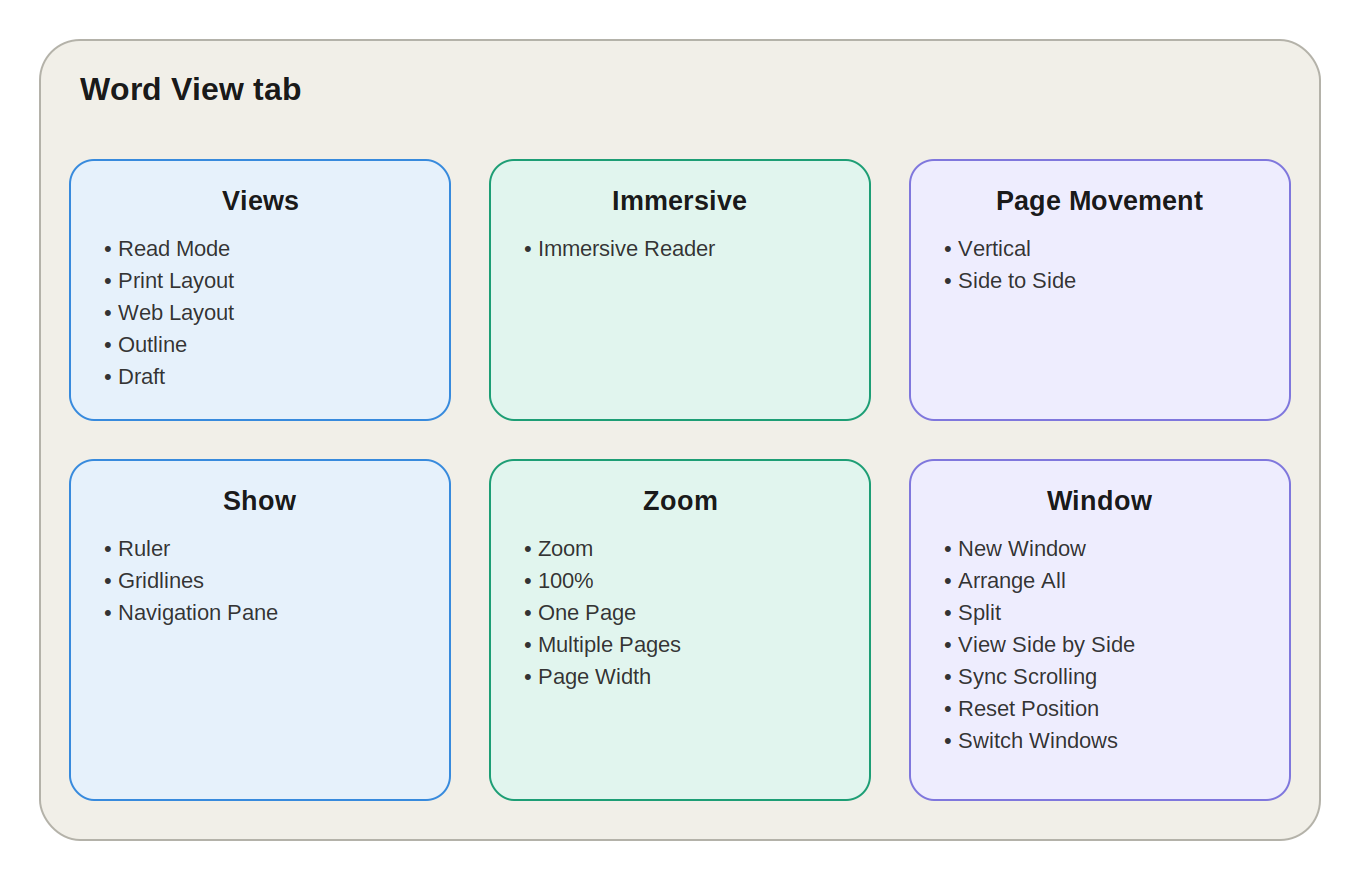
It has six groups: Views, Immersive, Page Movement, Show, Zoom, and Window.
1. Views Group
Switches between different ways of displaying the document.
- Read Mode – A distraction-free, book-like view optimized for reading rather than editing, with page-turning navigation.
- Print Layout – The default view, showing the document exactly as it will look when printed, including page breaks, margins, and headers/footers.
- Web Layout – Displays the document as a continuous scroll, similar to how it would appear as a webpage, without page breaks.
- Outline – Shows the document as a collapsible outline based on heading levels, useful for restructuring long documents by dragging headings to reorder entire sections at once.
- Draft – A simplified view showing text formatting but hiding headers, footers, and some page layout elements, useful for fast editing without visual clutter.
2. Immersive Group
- Immersive Reader – Opens the document in a full-screen reading experience with adjustable text spacing, column width, page color, and optional read-aloud narration — designed to improve readability and accessibility.
3. Page Movement Group
Controls how you scroll through a multi-page document (available in Print Layout view).
- Vertical – Standard up-and-down scrolling through pages.
- Side to Side – Scrolls horizontally, showing pages left to right instead of stacked vertically — mimics flipping through a physical book.
4. Show Group
Toggles optional visual guides on or off (checkboxes).
- Ruler – Shows horizontal and vertical rulers along the top and side of the page, useful for precisely setting margins, indents, and tab stops.
- Gridlines – Displays a faint grid across the page to help align objects, images, and text boxes precisely.
- Navigation Pane – Opens a sidebar showing document headings, page thumbnails, or search results, letting you jump to any section instantly (Ctrl+F also opens this).
5. Zoom Group
Controls how large or small the document appears on screen (visual only — doesn't affect printing).
- Zoom – Opens a dialog for a custom zoom percentage.
- 100% – Resets zoom to actual size.
- One Page – Fits exactly one full page in the visible window.
- Multiple Pages – Shows several pages at once, side by side, useful for reviewing overall document flow.
- Page Width – Zooms so the page width fills the visible window, regardless of vertical page count.
6. Window Group
Manages multiple document windows and views.
- New Window – Opens a second window showing the same document, letting you view two different sections at once.
- Arrange All – Tiles all open Word document windows on screen simultaneously.
- Split – Divides the current window into two independently scrollable panes of the same document, useful for referencing one section while editing another.
- View Side by Side – Displays two different documents next to each other for comparison.
- Synchronous Scrolling – When viewing side by side, scrolls both documents together at the same time.
- Reset Window Position – Restores side-by-side windows to equal, default sizing.
- Switch Windows – Dropdown listing all currently open Word documents, letting you jump between them.
When You'll Actually Use This Tab
- Read Mode – Reviewing a document on screen without editing it.
- Outline View – Reorganizing a long report or book draft by dragging headings to reorder whole sections.
- Navigation Pane – Quickly jumping around a long document by heading instead of scrolling manually.
- Multiple Pages / Zoom – Checking overall document layout and flow before printing.
- Split / View Side by Side – Comparing two sections of the same document, or two different documents, without switching back and forth.
Advertisement
💬 Leave a Comment & Rating