CPU Scheduling क्या है? Algorithms, Types और Examples हिंदी में
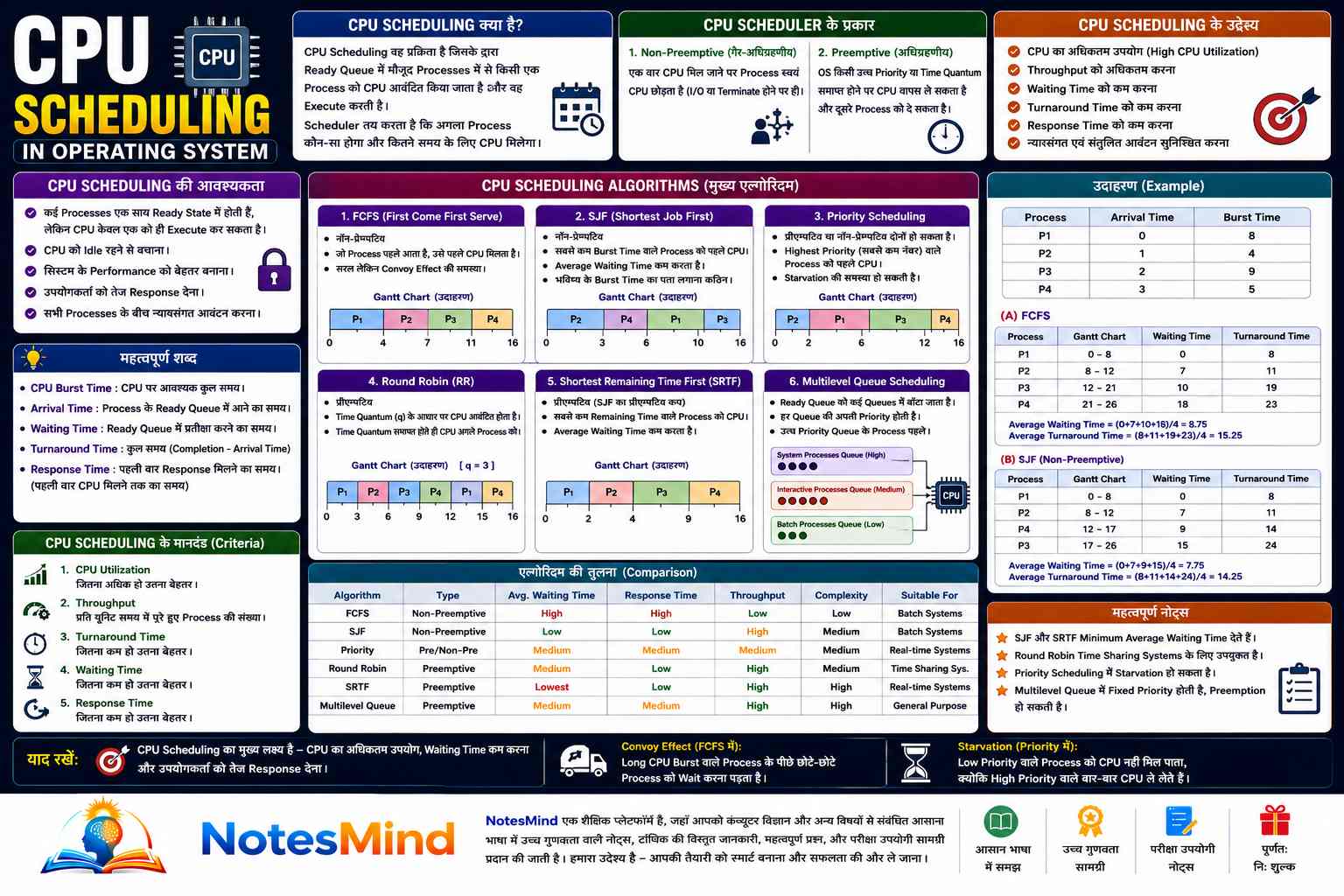
CPU Scheduling क्या है? — Algorithms, Types और Examples
CPU Scheduling वह process है जिसमें Operating System यह decide करता है कि Ready Queue में मौजूद processes में से कौन सा process अगला CPU पाएगा।
जब एक साथ कई programs चल रहे हों और CPU एक ही हो — तो किसे पहले chance मिलेगा? यह decision CPU Scheduler लेता है। इसके बिना CPU idle पड़ा रहेगा, programs slow होंगे, और users को lag महसूस होगा।
CPU Scheduling is the process of selecting one process from the Ready Queue and allocating the CPU to it.
Turnaround Time और Waiting Time को minimize करना, और CPU Utilization को maximum रखना — यही CPU Scheduling का असली goal है।
Real Life Example — Bank Counter
एक bank में एक Cash Counter है, लेकिन 10 customers लाइन में हैं। अब Bank Manager decide करेगा — किसे पहले serve करें?
Customers    →  Processes
Cash Counter →  CPU
Bank Manager →  Operating System
यही काम Computer में CPU Scheduler करता है — बस customers की जगह processes होती हैं।
CPU Scheduling क्यों ज़रूरी है?
Scheduling न हो तो:
| Problem | Effect |
|---|---|
| CPU Idle रहेगा | Processing time waste |
| Programs slow होंगे | User experience खराब |
| Response Time बढ़ेगी | Interactive systems fail |
| Throughput कम होगा | कम काम, ज़्यादा time |
| Resources waste होंगे | Inefficient system |
इसीलिए OS हमेशा CPU को busy रखने की कोशिश करता है।
CPU Scheduling के 6 मुख्य Objectives
1. Maximum CPU Utilization
Without Scheduling: CPU ──── Idle ────
With Scheduling:    P1 → P2 → P3 → P4
2. Maximum Throughput
1 Minute में:
Without Scheduling → 3 Processes complete
With Scheduling    → 8 Processes complete
3. Minimum Waiting Time
Ready Queue में process को कम से कम इंतज़ार करना पड़े।
4. Minimum Turnaround Time
Turnaround Time = Completion Time − Arrival Time
5. Minimum Response Time
पहली बार CPU मिलने में कम time लगे। Interactive systems में यह सबसे important है।
6. Fairness
हर process को CPU मिले — कोई भी हमेशा wait में न रहे।
CPU Scheduler कैसे काम करता है?
Ready Queue
  P1, P2, P3, P4
        │
        ▼
   CPU Scheduler
        │
        ▼
       CPU
OS का वह part जो Ready Queue से process चुनता है — वही CPU Scheduler है।
तीन Types के Schedulers
Schedulers
  ├── Long Term Scheduler
  ├── Medium Term Scheduler
  └── Short Term Scheduler
1. Long Term Scheduler (Job Scheduler)
New jobs को disk से उठाकर Ready Queue में लाता है। Degree of Multiprogramming control करता है — यानी एक समय में कितने processes memory में रहेंगे।
Disk → Long Term Scheduler → Ready Queue
2. Short Term Scheduler (CPU Scheduler)
Ready Queue से अगला process select करता है। यह सबसे ज़्यादा बार execute होता है — milliseconds में।
Ready Queue → CPU Scheduler → CPU
3. Medium Term Scheduler
Swapping करता है — process को memory से disk पर भेजना और वापस लाना।
Main Memory → Swap Out → Disk → Swap In → Memory
| Scheduler | काम | Frequency |
|---|---|---|
| Long Term | Jobs को memory में लाना | Infrequent |
| Short Term | CPU allocate करना | Very frequent |
| Medium Term | Swapping | Occasional |
Preemptive vs Non-Preemptive Scheduling
Non-Preemptive Scheduling
CPU मिलने के बाद process खुद complete होती है — बीच में कोई CPU नहीं छीन सकता।
P1 ──────────── Finish
P2              Wait...
P3              Wait...
Examples: FCFS, Non-Preemptive SJF, Non-Preemptive Priority
Preemptive Scheduling
OS ज़रूरत पड़ने पर process से CPU वापस ले सकता है।
P1 runs → Time Over → CPU वापस → P2 runs
Examples: Round Robin, SRTF, Preemptive Priority
| Feature | Non-Preemptive | Preemptive |
|---|---|---|
| CPU छीना जा सकता है? | ❌ | ✅ |
| Response Time | ज़्यादा | कम |
| Context Switching | कम | ज़्यादा |
| Interactive Systems | खराब | अच्छा |
CPU Scheduling Algorithms — विस्तार से
1. FCFS — First Come First Serve
Definition: जो process पहले arrive करे, उसे CPU पहले मिले। Ticket counter की तरह — पहले आओ, पहले पाओ।
Example:
| Process | Arrival Time | Burst Time |
|---|---|---|
| P0 | 0 | 5 |
| P1 | 1 | 3 |
| P2 | 2 | 8 |
| P3 | 3 | 6 |
Gantt Chart:
0        5        8        16       22
|   P0   |   P1   |   P2   |   P3   |
Waiting Time Calculation:
Waiting Time = Service Time − Arrival Time
| Process | Service Time | Arrival Time | Waiting Time |
|---|---|---|---|
| P0 | 0 | 0 | 0 |
| P1 | 5 | 1 | 4 |
| P2 | 8 | 2 | 6 |
| P3 | 16 | 3 | 13 |
Average Waiting Time = (0 + 4 + 6 + 13) / 4 = 5.75 ms
| फायदे ✅ | नुकसान ❌ |
|---|---|
| सबसे आसान algorithm | Convoy Effect होता है |
| कम overhead | Average waiting time ज़्यादा |
| Implement करना simple | Interactive systems के लिए poor |
Convoy Effect क्या है? एक long process सबके आगे आ जाए तो सब छोटी processes उसका इंतज़ार करती रहती हैं — जैसे highway पर एक slow truck सबको रोक दे।
2. SJF — Shortest Job First
Definition: जिस process का Burst Time सबसे कम हो, उसे पहले CPU मिले।
Example:
| Process | Burst Time |
|---|---|
| P0 | 5 |
| P1 | 3 |
| P2 | 8 |
| P3 | 6 |
Execution Order: P1 (3) → P0 (5) → P3 (6) → P2 (8)
Gantt Chart:
0      3      8      14      22
|  P1  |  P0  |  P3  |  P2  |
Waiting Time:
| Process | Waiting Time |
|---|---|
| P1 | 0 |
| P0 | 3 |
| P3 | 8 |
| P2 | 14 |
Average Waiting Time = (0 + 3 + 8 + 14) / 4 = 5 ms
| फायदे ✅ | नुकसान ❌ |
|---|---|
| Minimum average waiting time | Burst time पहले से पता होना चाहिए |
| Best theoretical performance | Starvation हो सकता है |
Burst time predict करना practically मुश्किल है — यही SJF की सबसे बड़ी limitation है।
3. Priority Scheduling
Definition: हर process को एक priority value मिलती है। Highest priority वाला process पहले execute होता है।
Example:
| Process | Priority |
|---|---|
| P0 | 1 |
| P1 | 2 |
| P2 | 1 |
| P3 | 3 |
अगर 1 = Highest Priority, तो execution order:
P0 → P2 → P1 → P3
समान priority होने पर FCFS apply होता है।
| फायदे ✅ | नुकसान ❌ |
|---|---|
| Important jobs पहले complete | Low priority process starve हो सकती है |
| Real-time systems के लिए useful | Aging implement करना पड़ता है |
Solution — Aging: जितना ज़्यादा wait करो, priority उतनी बढ़ती जाए — eventually CPU ज़रूर मिलेगा।
4. Round Robin Scheduling
Definition: हर process को एक fixed time (Time Quantum / Time Slice) मिलता है। Time खत्म हुआ — CPU वापस, अगली process की बारी।
यह Preemptive algorithm है। Interactive systems के लिए सबसे suitable।
Example (Time Quantum = 3 ms):
| Process | Arrival Time | Burst Time |
|---|---|---|
| P0 | 0 | 5 |
| P1 | 1 | 3 |
| P2 | 2 | 8 |
| P3 | 3 | 6 |
Execution:
0-3:  P0 (3 ms)
3-6:  P1 (3 ms) → P1 Complete ✅
6-9:  P2 (3 ms)
9-12: P3 (3 ms)
12-14: P0 (2 ms) → P0 Complete ✅
14-17: P2 (3 ms)
17-20: P3 (3 ms) → P3 Complete ✅
20-22: P2 (2 ms) → P2 Complete ✅
Gantt Chart:
0   3   6   9  12  14  17  20  22
|P0 |P1 |P2 |P3 |P0 |P2 |P3 |P2 |
| फायदे ✅ | नुकसान ❌ |
|---|---|
| Fair scheduling | Context switching ज़्यादा |
| Interactive systems के लिए best | Time quantum बहुत छोटा हो तो performance गिरती है |
| Response time अच्छा | Time quantum बड़ा हो तो FCFS जैसा हो जाता है |
Time Quantum कितना होना चाहिए? न बहुत छोटा, न बहुत बड़ा। Practically 10-100 ms standard माना जाता है।
5. Multi-Level Queue Scheduling
अलग-अलग type की processes को अलग-अलग queues में रखा जाता है — हर queue का अपना algorithm होता है।
Highest Priority
      │
      ▼
System Processes Queue      → Priority Scheduling
      ▼
Interactive Queue           → Round Robin
      ▼
Editing Queue               → Round Robin
      ▼
Batch Queue                 → FCFS
      ▼
User Queue                  → FCFS
      │
Lowest Priority
| Queue | Scheduling Algorithm |
|---|---|
| System | Priority |
| Interactive | Round Robin |
| Batch | FCFS |
Real systems जैसे Linux और Windows इसी concept का use करते हैं — different processes को different treatment मिलती है।
सभी Algorithms की तुलना
| Algorithm | Preemptive | आधार | फायदा | नुकसान |
|---|---|---|---|---|
| FCFS | ❌ | Arrival Time | सबसे simple | Convoy Effect, high wait time |
| SJF | ❌ (SRTF = ✅) | Shortest Burst | Minimum waiting time | Burst time predict करना मुश्किल |
| Priority | दोनों | Priority Value | Important process पहले | Starvation |
| Round Robin | ✅ | Time Quantum | Fair, best for interactive | ज़्यादा context switching |
| Multi Queue | दोनों | Multiple Queues | Different processes के लिए flexible | Complex management |
FAQ — CPU Scheduling के Common Questions
Q1. Round Robin में Time Quantum कितना बड़ा होना चाहिए?
Time Quantum बहुत छोटा हो तो context switching overhead बढ़ता है — CPU time process switch करने में waste होती है। बहुत बड़ा हो तो Round Robin basically FCFS बन जाता है। Practically 10ms से 100ms के बीच रखा जाता है। Rule of thumb — Time Quantum, average burst time से थोड़ा ज़्यादा होना चाहिए।
Q2. SJF को Optimal क्यों कहते हैं लेकिन practically कम use होता है?
SJF theoretically minimum average waiting time देता है — इसीलिए optimal है। लेकिन practically, OS को पहले से नहीं पता कि अगले process का burst time कितना होगा। इसे predict करना पड़ता है — और prediction हमेशा accurate नहीं होती। यही practical limitation है।
Q3. Preemptive और Non-Preemptive में कौन सा better है?
यह situation पर depend करता है। Interactive systems (web browsers, games, ATM) में Preemptive better है — response time कम रहता है। Batch processing (video rendering, data backup) में Non-Preemptive ठीक है — context switching overhead कम होता है। Modern OS दोनों mix करते हैं।
💬 Leave a Comment & Rating