Integrity Constraints
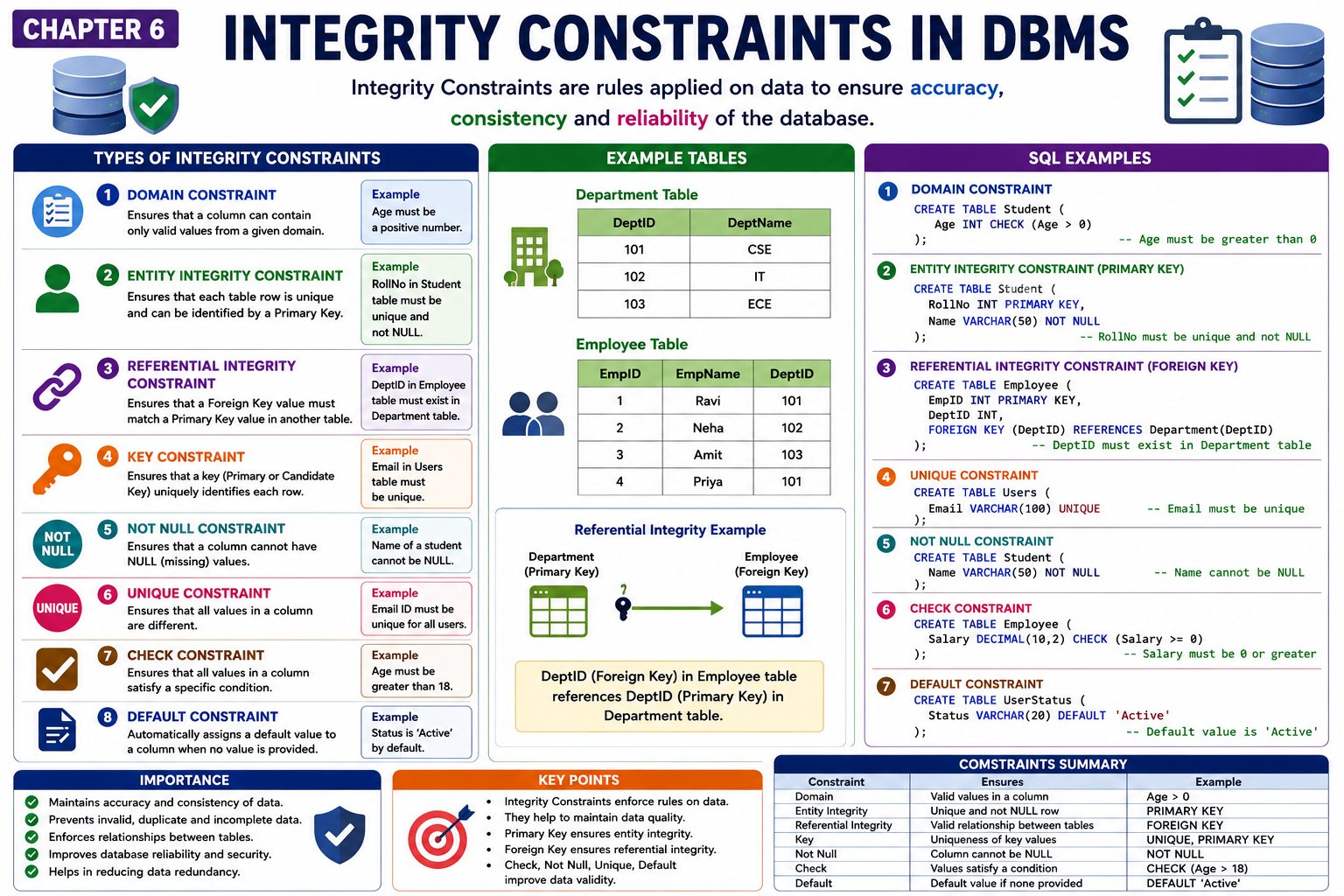
Integrity Constraints are rules applied to database tables to ensure that the data stored is accurate, valid, and consistent.
Definition
Integrity Constraints वे नियम (Rules) हैं जो Database में गलत (Invalid) या Duplicate Data को आने से रोकते हैं और Data की Accuracy, Consistency और Reliability बनाए रखते हैं।
Simple Definition
Integrity Constraints = Database के Traffic Rules
जैसे सड़क पर Traffic Rules दुर्घटनाओं को रोकते हैं, वैसे ही Database में Integrity Constraints गलत डेटा को रोकते हैं।
Why Do We Need Integrity Constraints?
Imagine a Student table.
| StudentID | Name | Age |
|---|---|---|
| 101 | Rahul | 20 |
| 101 | Aman | 21 |
| NULL | Neha | 19 |
| 105 | Priya | -5 |
Problems:
- Duplicate StudentID ❌
- NULL Primary Key ❌
- Negative Age ❌
These errors reduce data quality.
Integrity Constraints prevent such problems.
Objectives of Integrity Constraints
-
Prevent invalid data.
- Maintain consistency.
- Avoid duplicate records.
- Protect relationships between tables.
- Improve data quality.
- Increase database reliability.
Types of Integrity Constraints
There are six major constraints.
              Integrity Constraints
                     │
 ┌──────────┬──────────┬──────────┬──────────┬──────────┬──────────┐
 │          │          │          │          │          │
Domain   Entity   Referential   Key      Check    Default
We will study each one in detail.
Domain Constraint
Definition
A Domain Constraint restricts the values that can be stored in a column.
Every attribute has a predefined domain.
Example
Age
Allowed values:
18 – 60
Valid
25 30 45
Invalid
-5
120
ABC
Real-Life Example
Gender
Allowed values:
Male

Female

Other
Not allowed:
Apple

123

Teacher
SQL Example
CREATE TABLE Student
(
    Age INT CHECK(Age>=18 AND Age<=60)
);
Entity Integrity Constraint
Definition
The Primary Key of a table:
- Cannot be NULL.
- Must be unique.
Example
Student Table
| StudentID | Name |
|---|---|
| 101 | Rahul |
| 102 | Aman |
Valid ✔
Invalid
| StudentID | Name |
|---|---|
| NULL | Rahul |
❌ Primary Key cannot be NULL.
Duplicate
| StudentID | Name |
|---|---|
| 101 | Rahul |
| 101 | Aman |
❌ Duplicate Primary Key is not allowed.
SQL Example
CREATE TABLE Student
(
    StudentID INT PRIMARY KEY,
    Name VARCHAR(50)
);
Referential Integrity Constraint
Definition
A Foreign Key must always refer to an existing Primary Key value in the parent table.
Parent Table
Student
| StudentID | Name |
|---|---|
| 101 | Rahul |
| 102 | Aman |
Child Table
Enrollment
| StudentID | Course |
|---|---|
| 101 | DBMS |
Valid ✔
Invalid
| StudentID | Course |
|---|---|
| 999 | DBMS |
Student 999 does not exist.
❌ Not allowed.
Diagram
Student
------------------
StudentID (PK)

101

102

        │
        ▼

Enrollment

StudentID (FK)

101 ✔

999 ❌
SQL Example
CREATE TABLE Enrollment
(
StudentID INT,
Course VARCHAR(50),

FOREIGN KEY(StudentID)

REFERENCES Student(StudentID)
);
Why Referential Integrity?
Without it:
Student deleted
↓
Enrollment still exists
↓
Invalid database
Referential Integrity prevents this.
Parent and Child Tables
Parent Table
↓
Primary Key
↓
Referenced by
↓
Child Table
↓
Foreign Key
Key Constraint
Definition
Every table should have a key that uniquely identifies records.
Example
| EmployeeID | Name |
|---|---|
| 101 | Rahul |
| 102 | Aman |
EmployeeID is unique.
Duplicate EmployeeID is not allowed.
NOT NULL Constraint
Definition
A NOT NULL column must always contain a value.
Example
CREATE TABLE Student
(
Name VARCHAR(50) NOT NULL
);
Valid
| Name |
|---|
| Rahul |
Invalid
| Name |
|---|
| NULL |
UNIQUE Constraint
Definition
The UNIQUE constraint ensures that all values in a column are different.
Example
| rahul@gmail.com |
| aman@gmail.com |
Valid ✔
Duplicate
| rahul@gmail.com |
| rahul@gmail.com |
❌ Invalid
SQL Example
CREATE TABLE Student
(
Email VARCHAR(50) UNIQUE
);
Primary Key vs UNIQUE
| Primary Key | UNIQUE |
|---|---|
| Only one per table | Multiple UNIQUE constraints allowed |
| Cannot be NULL | NULL handling depends on the DBMS |
| Main identifier | Prevents duplicate values |
CHECK Constraint
Definition
CHECK verifies that a value satisfies a condition.
Example
Salary
Must be greater than 10,000.
CHECK(Salary>10000)
Age
CHECK(Age>=18)
Valid
Age = 25 ✔
Invalid
Age = 15 ❌
SQL Example
CREATE TABLE Employee
(
Salary INT CHECK(Salary>=10000)
);
DEFAULT Constraint
Definition
If no value is provided, the DEFAULT value is automatically inserted.
Example
Country
Default:
India
SQL
CREATE TABLE Student
(
Country VARCHAR(20)

DEFAULT 'India'
);
Insert
INSERT INTO Student(Name)

VALUES('Rahul');
Result
| Name | Country |
|---|---|
| Rahul | India |
Complete Student Table
CREATE TABLE Student
(
StudentID INT PRIMARY KEY,

Name VARCHAR(50) NOT NULL,

Email VARCHAR(50) UNIQUE,

Age INT CHECK(Age>=18),

Country VARCHAR(20)

DEFAULT 'India'
);
Visual Summary
Student Table

StudentID

↓

Primary Key

↓

Unique

↓

NOT NULL

-------------------------

Email

↓

UNIQUE

-------------------------

Age

↓

CHECK

-------------------------

Country

↓

DEFAULT

-------------------------

DepartmentID

↓

FOREIGN KEY
Real-Life Example
Bank Database
Customer Table
| CustomerID | Name |
|---|---|
| 101 | Rahul |
Account Table
| AccountNo | CustomerID |
|---|---|
| 5001 | 101 |
Rules:
- CustomerID unique ✔
- CustomerID cannot be NULL ✔
- Account linked with Customer ✔
- Balance ≥ 0 ✔ (CHECK)
Advantages of Integrity Constraints
-
Accurate data
- No duplicate records
- Strong relationships
- Better security
- Easy maintenance
- High reliability
- Better database performance
Disadvantages
- Slight overhead during insert/update operations
- Complex rules may slow large transactions
- Require proper database design
💬 Leave a Comment & Rating